
Honoring All Parts
A Seat for Every Voice
Remembering and re-membering our wholeness
Meet the protective parts that work so hard to keep you safe.
When things get tense, parts of us speak up. One pushes back, one rushes away, one goes still, one smooths things over, one lets go. They are not who we are. They are guests who learned their jobs for good reasons. Hapag (table) is the Filipino word for table, and at a hapag there is always room for one more.
A note on accessibility
This online version leans on reading, writing, and quiet reflection on a screen. That works for some of us and not for others. Many of us make sense of things by talking, moving, drawing, listening, or being with others, and reading on a screen can take a lot of energy. If this format does not fit how you process, that says nothing about you. It is a limitation of this version. Take what helps and leave the rest. You can pause anytime, write a single word, or simply sit with a question. The cards and facilitated sessions offer other ways in.
Five protective parts, 45 voices
Voices at the door
Each protective part speaks through its own voice: the quick yes, the sharp edge, the busy one, the blank, the switch-off. Nine voices for each part, each one naming the fear, belief, or need it is carrying for you. Choose a part to meet it.
Protecting by pushing back
Fight
Rises when dignity, safety or the right to take up space feels threatened. It guards your right to be heard.
Tap the poster to read its nine voices.
Protecting by moving away
Flight
When things feel like too much, it moves: out of the room, into busyness, into the future.
Tap the poster to read its nine voices.
Protecting by holding still
Freeze
When fighting and leaving both feel impossible, the body goes quiet and waits for the danger to pass.
Tap the poster to read its nine voices.
Protecting by appeasing
Fawn
It smooths, accommodates and keeps others comfortable. Relational intelligence, formed where belonging was conditional.
Tap the poster to read its nine voices.
Protecting by letting go
Flop
When it is all too much for too long, it lets go: of energy, of feeling, of holding on.
Tap the poster to read its nine voices.
Start here · Free · About 30 minutes
Meet your protective parts
The online assessment gently shows which protective parts tend to show up when things get tense. You listen to the voices at your own pace, see how your five protective parts show up for you, and spend a little time with one guest. Our protective parts shift with our capacity, our context, and the people around us. What you see is a picture of now, not a diagnosis.
Begin the assessmentPrivate. Nothing you choose is shared. Download your table when you finish. This is a space for gentle self-reflection, not a substitute for therapy or medical care.
- Listen to the voices at the doorHolding a tense moment nearby, sort 45 voices into three piles: often at my table, sometimes at my table, or not tonight. Names stay hidden, so you respond to how a voice sounds, not to a label.
- See your protective partsDiscover which of the five parts most often pull up a chair for you, and what each one is guarding.
- Sit with one guestInvite one voice to your table. Ask it a question from the past, the present and the future, receive its pabaon (provisions for the journey), the gift it sends you home with, and choose one anchor for the coming weeks.
For coaches and facilitators
You are welcome to take this reflection yourself and to share the link freely with friends, colleagues, clients, teams, and communities. It works well before a first session, as a shared language for what happens under stress, or as an opening for a team conversation. Please share the link rather than copies, and don’t charge for access. If you would like to build it into a paid program, workshop, or training, please get in touch first: hello@lanajelenjev.com
For teams and organizations
When protection comes to work
Under pressure, teams protect too. Someone pushes back, someone rushes ahead, someone goes quiet, someone keeps the peace, someone quietly checks out. When we can name these patterns with care, they stop being sources of blame and become information about what people need to feel safe enough to do their best work together.
Protection is intelligence
Every protective response serves a purpose for good reason. Meeting it with curiosity rather than judgment helps people to pause, reflect, and respond to what lies beneath the behavior.
Patterns live in systems too
Protective patterns are not only personal. They are shaped by histories, structures, and cultures of work. Seeing them together helps teams change the conditions that keep people on guard, so fewer of us need to protect so hard.
Shaped around your people and your needs
These are starting points. We design every engagement around you, so the best first step is a conversation.
Tell me about your team and what you hope for. I will come back with a proposal.
Coming soon · For coaches, leaders and facilitators
The Honoring All Parts toolkit
For coaches, leaders and facilitators who would like to work with the Honoring All Parts methodology in their own practice: with clients, with teams and in communities. Everything you need to set the table, for protective parts and resourced parts alike.
Would you like to hear when the toolkit is ready? Write to me and I will let you know.
Voice cards, the feelings, needs and beliefs beneath each part, practices, and cards for exploring patterns in teams and communities.
Session designs, processes and principles for holding this work with individuals, teams and communities.
A guided journey to meet each voice at the table, with reflection prompts and a pabaon (provisions for the journey) for every guest.
Small practices to carry from each voice, for the weeks after a session.
The five protective parts, feelings, and needs, and their voices, for the wall of a workshop room or a coaching space.
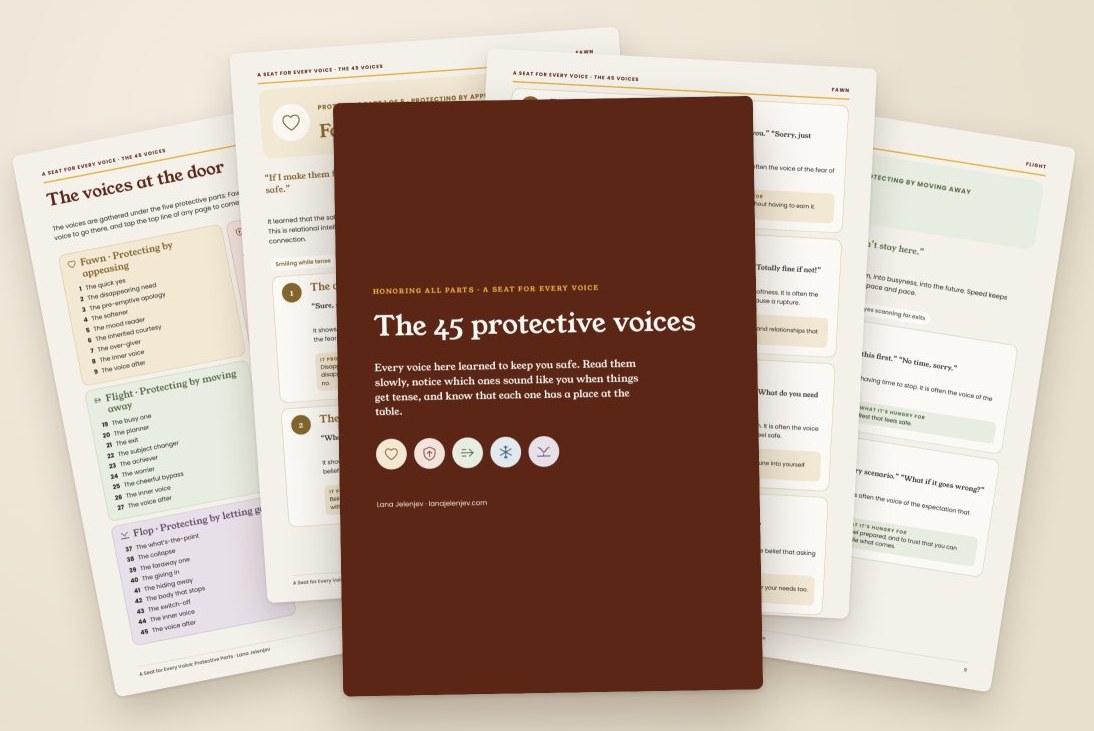
Free hand-out · PDF
The 45 protective voices
All the voices from the assessment, gathered in one place and grouped by part. For each voice: the words it tends to say, how it shows up, what it protects you from, and what it is hungry for. Keep it beside you after the assessment, bring it to a coaching session, or use it with a group to build a shared language for what happens under pressure.
Download for free